How to Verify a Chinese Manufacturer Before Payment
Verify the transaction—not just the factory. Reconcile the company, payment recipient, production chain, and buyer controls before funds move.
Quick answer. To verify a Chinese manufacturer before paying a deposit, establish five things: the exact legal entity you are contracting with, the entity receiving your money, the company or facility controlling production, the evidence supporting the supplier’s order-specific claims, and the leverage you retain if the order does not conform. A business license, marketplace badge, sample, certificate, photograph, video call, factory audit, or product inspection can each answer a useful question, but none answers all five. The practical goal is not to label a supplier “safe.” It is to verify the proposed transaction well enough to decide whether to proceed, change the terms, obtain more evidence, commission a physical check, or pause payment.
The five things to establish before money moves:
- Who you are legally contracting with.
- Who receives each payment and why.
- Who actually controls the factory, tooling, materials, and subcontractors.
- Which reliable evidence supports each material claim.
- What contractual and practical recourse remains if the order fails.
Why Smart Companies Still Make Expensive Mistakes
A surprising number of failed sourcing projects begin with suppliers that looked completely legitimate.
The company existed. The factory existed. The samples were good. The certificates were valid.
The problem wasn’t the absence of evidence. It was the wrong interpretation of evidence.
Businesses rarely lose money because they skipped verification. They lose money because they verified the wrong assumptions. Every document answers a question. Very few answer the question that actually matters.
Our approach focuses on a different question: “Does the available evidence justify this commercial decision?”
Supplier Verification, Factory Audit, and Product Inspection Are Different
These processes are complementary, not interchangeable. Supplier verification or a pre-payment transaction review tests the identity and relationship of the parties, the payment structure, and the evidence behind supplier claims. A factory audit evaluates a named facility and its systems or capabilities at the time of the audit. A product inspection compares an identified production lot or shipment with agreed specifications and acceptance criteria. A company check does not establish shipment quality, and a factory audit does not reconcile an unexplained beneficiary account.
A Registered Company Is Not the Same as a Verified Transaction
Chinese manufacturer business license verification is a necessary identity check, but it is only the first layer. China’s National Enterprise Credit Information Publicity System allows a search by company name, Unified Social Credit Code, or registration number and publishes corporate and credit information from market-regulation authorities and other contributors.[1] The business license normally carries an 18-character Unified Social Credit Code.[2]
That evidence can confirm the registered legal name, status, legal representative, address, business scope, and other public fields. It does not prove that the licensed entity owns the factory shown in a sales presentation, controls the machinery or subcontractors, has capacity for your order, or is the party named in the bank instructions. Business scope, registered capital, operating history, and litigation records are context, not stand-alone verdicts.
A transaction becomes supportable only when four facts align: the legal entity exists; its relationship to the production operation is documented; the production chain can plausibly execute the exact product, volume, and schedule; and the contract, payment, inspection, and remedy structure preserves meaningful leverage. Verification is therefore an evidence-and-control exercise, not a collection of reassuring badges.
Map the Four Chains Behind the Transaction
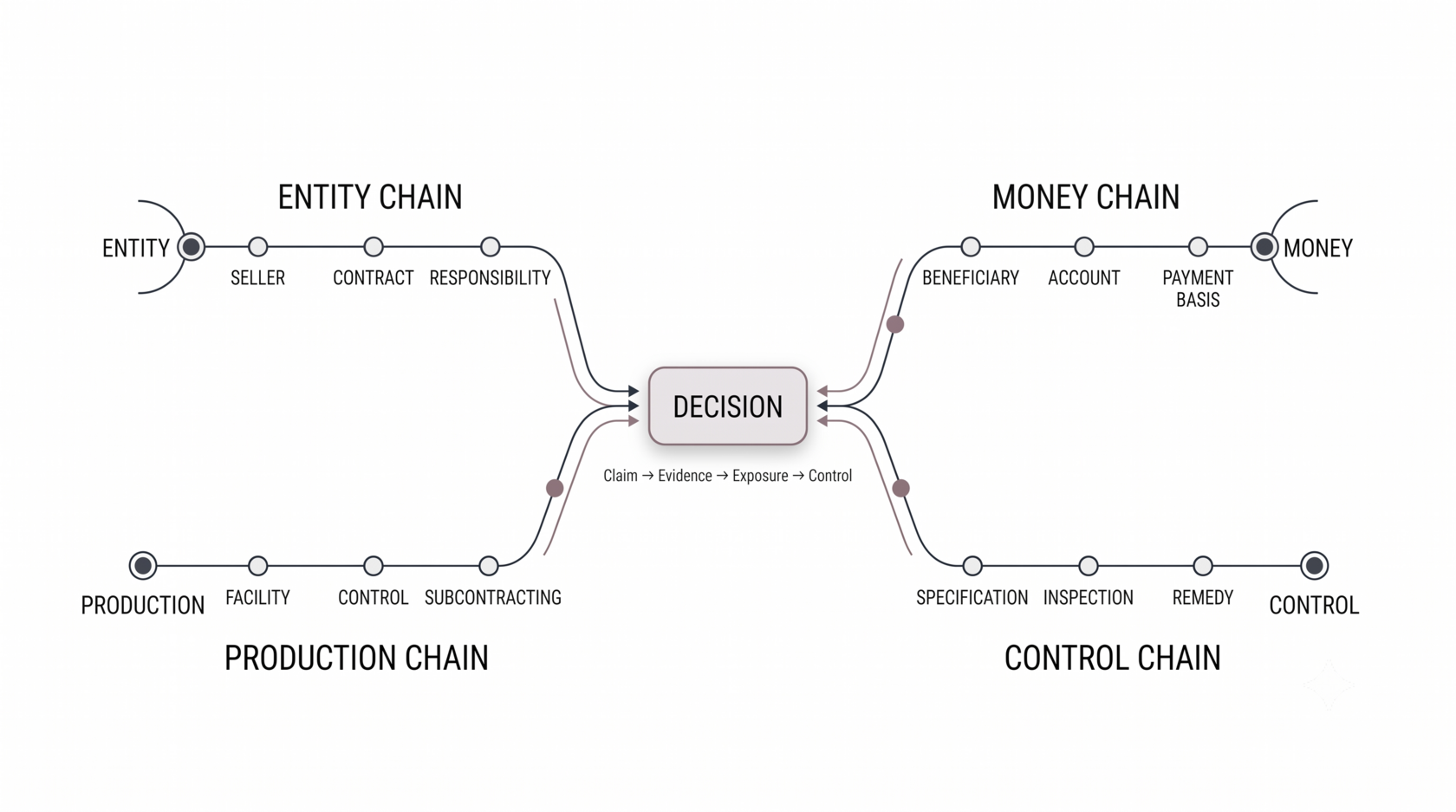
Arbitr's approach rests on a broader discipline we call Decision Architecture — the philosophy behind how we approach commercial decisions under uncertainty. The Four-Chain Transaction Map is the primary analytical tool within that philosophy: it organizes the evidence around the four relationships that determine whether money should move:
- Entity chain — who sells, contracts, invoices, exports, communicates, and accepts responsibility.
- Money chain — who receives each payment, into which account, under which legal name, and on what documented basis.
- Production chain — who owns, leases, operates, manages, or controls the factory, tooling, materials, and subcontractors.
- Control chain — what specifications, inspections, payment triggers, remedies, and escalation rights remain if performance fails.
- How reliable is it?
- What does it actually prove?
- What remains unknown?
Then test the evidence against Source → Entity → Scope → Date. A genuine document may still be irrelevant if it concerns the wrong company, a different site, another product or model, an expired period, or a narrower scope than the claim being made. Once we’ve identified the remaining uncertainty, we define what should change before capital is committed—whether that’s documenting relationships between entities, revising payment terms, requiring inspections, staging payments, or pausing the transaction altogether.
Common Decision Traps
Verification failures are rarely caused by a lack of documents. They are caused by cognitive shortcuts that misread the evidence that is already available. The following assumptions recur across failed transactions:
- Assuming a registered company controls production. A verified legal entity confirms identity, not factory ownership.
- Assuming an approved sample guarantees production consistency. A sample verifies one unit at one point in time, not the system that will manufacture the full order.
- Assuming payment instructions explain themselves. A real bank account does not establish why that account is entitled to receive this transaction’s funds.
- Assuming more documents automatically reduce uncertainty. Additional paperwork only helps if it answers Source → Entity → Scope → Date for the claim in question.
- Assuming every inconsistency indicates fraud. Multiple entities or a change of facility can have a legitimate explanation; the question is whether that explanation is documented before payment.
These are decision traps, not checklist failures. The goal is to catch them before capital moves.
Case Example: When the Documents Do Not Describe One Transaction
Illustrative worked example, not a client result. This example demonstrates the method without claiming a real Arbitr engagement or outcome.
The quotation looks normal. The factory looks real. The sample is approved. Then, just before the deposit is due, the beneficiary suddenly changes to a Hong Kong company you’ve never seen before. Nothing may be wrong. But now you’re making a different decision than the one you thought you were making.
A buyer communicates through an online storefront branded as Company A. The business license supplied during due diligence belongs to Company B. The quotation and pro forma invoice are issued by Company C. The payment request names a Hong Kong beneficiary that is not clearly identified in the contract. A live walkthrough shows production at a facility operated by Company D.
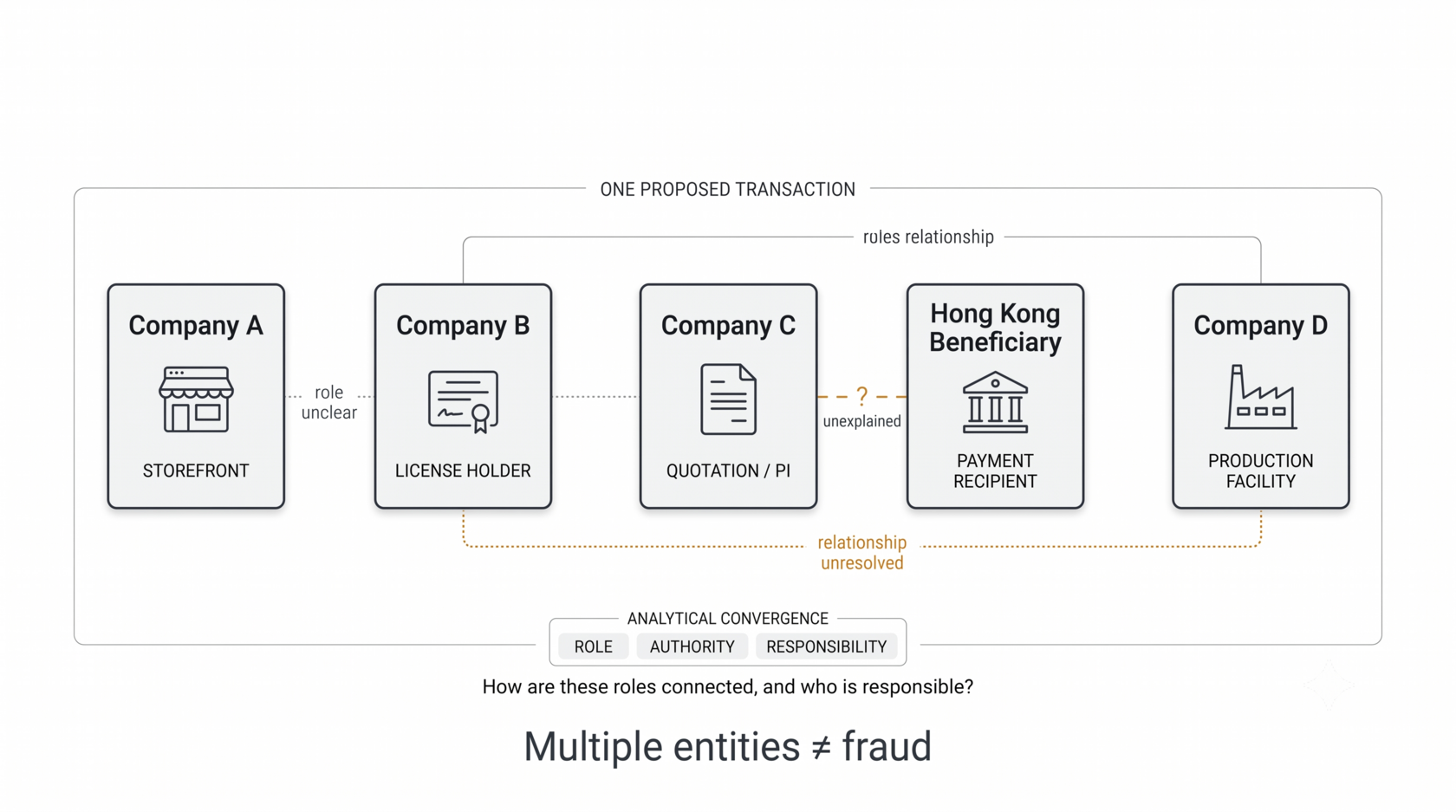
The entity chain is incomplete because the storefront, license holder, PI issuer, and production operator do not yet connect. The money chain is incomplete because the beneficiary’s authority to receive the deposit is unexplained. The production chain is incomplete because access to a facility does not establish ownership, control, or allocation of the buyer’s order. The control chain is weak if the buyer must pay before those relationships are resolved.
A defensible next step is not to declare the supplier fraudulent. It is to pause the deposit and request a written entity map, supporting affiliate or agency documents, independently confirmed bank instructions, authority confirmation for the sales contact, and contract language identifying the party responsible for production, defects, tooling, and repayment or rework obligations. The decision changes when the evidence changes.
The Five Tests That Matter Before Payment
Each test asks what must be established, what evidence is useful, what the evidence cannot prove alone, and what control may be required before payment.
Test 1 — Identity and Contact Authority
What must be established. Confirm the exact Chinese legal name and Unified Social Credit Code of the contracting party, its current status, and whether the same entity appears consistently on the quotation, PI, contract, marketplace profile, website, company seal, and bank instructions. Where several entities appear, identify the role and authority of each one.
Relevant evidence. Obtain the business license and search the official corporate registry. Verify the sales contact through independently sourced company channels, not only the telephone number or email in the same message thread. Confirm changed bank instructions through a previously verified channel. For buyers searching “China export license verification,” avoid requesting an outdated general “Foreign Trade Operator Registration”: China abolished that filing requirement on December 30, 2022.[3] For ordinary goods, check whether the relevant Chinese entity is filed with Customs as a consignee or consignor of import/export goods and review its public Customs information; product-specific permits may still be required.[4]
What it cannot prove alone. A valid company, customs filing, or corporate-domain email does not prove factory control, order capability, or future performance. A different beneficiary is not automatic proof of fraud, but it is a stop-and-resolve issue.
Control before payment. Require a documented relationship among the contracting, payment, export, and production entities; independently confirm the person authorized to issue instructions; and treat any last-minute beneficiary change as a new verification event.
Test 2 — Production Reality
What must be established. Identify where the product will actually be made and who owns, leases, operates, manages, or controls that facility, its tooling, materials, and subcontractors.
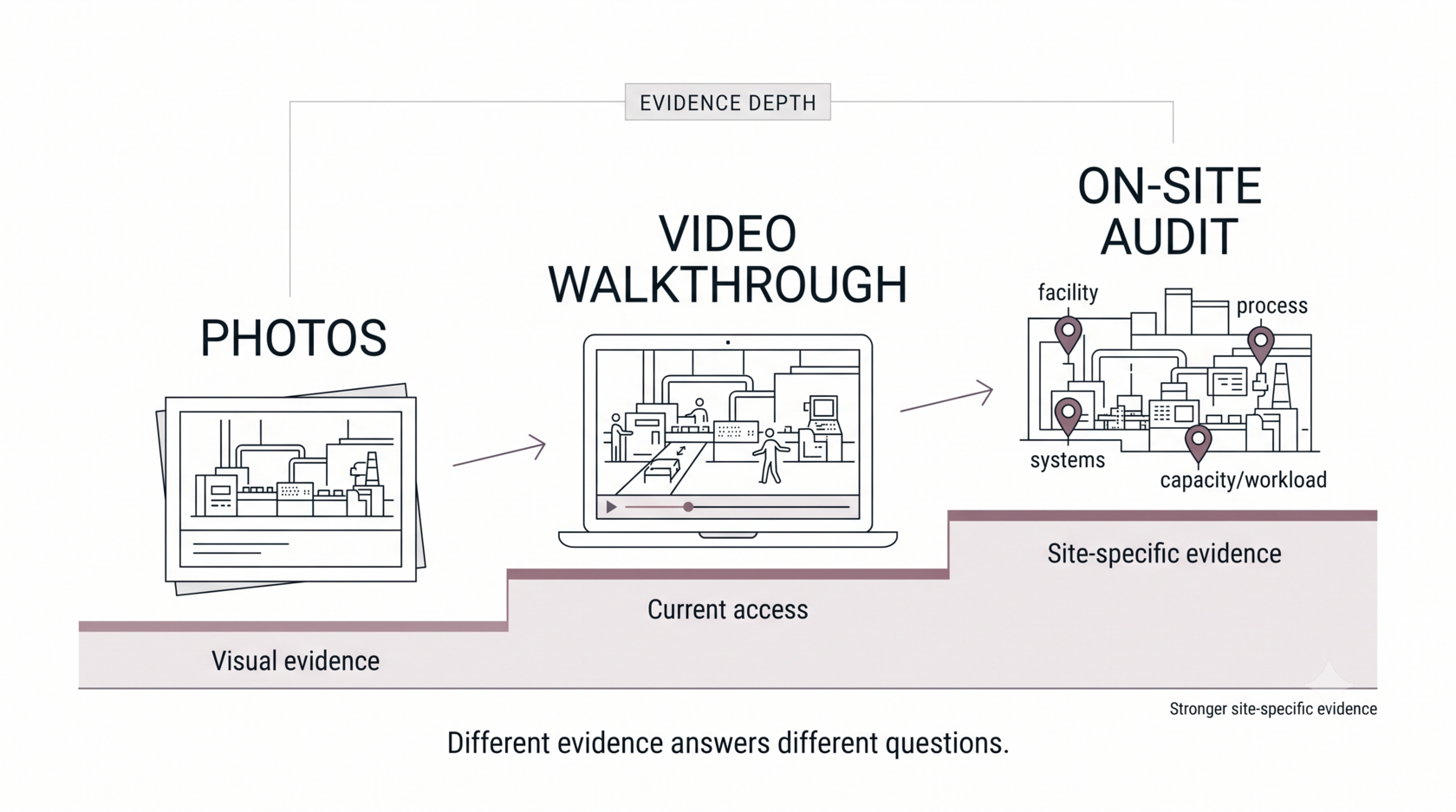
Relevant evidence. Ask for the exact production address, the facility’s legal entity, current process evidence, relevant machinery, production flow, workforce, and any subcontracting plan. An independently scheduled live video walkthrough can show current access and activity, but it should not be described as a full factory audit. For higher exposure, an independent on-site audit provides stronger site-specific evidence and can assess systems, capability, and workload against defined criteria.[5]
Control before payment. Document who may produce, whether subcontracting is allowed, who owns the tooling and materials, who controls quality, and who remains responsible if the actual producer is different from the seller.
Test 3 — Order Capability
What must be established. Determine whether the production chain can make your exact product at the required tolerance, volume, and schedule, not merely a similar product.
Relevant evidence. Review product-specific processes, critical materials, tooling, bottlenecks, changeovers, maintenance, labor availability, current utilization, reject or rework information, material lead times, and technical answers. Capacity calculations can test plausibility, but the inputs must be traceable and the result must reflect the buyer’s product and available production time.
What it cannot prove alone. Machine count, a stated monthly capacity, or one successful sample does not prove repeatable bulk output or future allocation. In one transaction, a supplier sent beautifully printed business cards as the production sample. The sample looked perfect. The paper quality matched expectations. The colors were correct. The order was approved. Weeks later, the production run arrived. The cards had been printed at a different facility using different paper and a different printing process. Nothing was technically “wrong.” But they were no longer the product that had been approved. The project missed an important deadline while the order had to be reproduced. The supplier was not fraudulent — the approved sample had simply verified one moment in time, not the production system that would manufacture the full order.
Control before payment. Approve a written specification and golden sample, define change-control and subcontracting rules, use a trial where proportionate, and connect later payments to production evidence or inspection rather than to the calendar alone.
Test 4 — Product and Compliance Evidence
What must be established. Confirm that the specifications, certificates, and test reports concern the entity, facility, product or model, standard, market, and production version relevant to the proposed order.
Relevant evidence. Define objective specifications, tolerances, materials, packaging, labeling, and acceptance criteria. For buyers searching “ISO 9001 certificate verification China,” remember that ISO develops the standard but does not issue certificates. Verify the certification body, accreditation, certificate status, named organization, sites, scope, standard edition, and dates through IAF CertSearch, the issuing body, or the accreditation body.[6] Apply the same Source → Entity → Scope → Date discipline to test reports and product certificates.
What it cannot prove alone. ISO 9001 concerns a quality management system; it is not a product certificate and does not prove that the current batch meets your specification. Product-specific U.S. compliance may require accredited laboratory testing, engineering review, regulatory analysis, or legal advice outside a commercial supplier review.
Control before payment. Tie the contract and inspection checklist to the approved specification and sample, require written approval for changes, and identify which evidence must be refreshed if the model, material, facility, or standard changes.
Test 5 — Transaction Control
What must be established. Decide how much leverage remains after each payment and what happens if the supplier misses the specification, schedule, quantity, or inspection criteria.
Relevant evidence. Review the commercial reason for the deposit, payment milestones, tooling and material commitments, inspection rights, acceptance criteria, reinspection and rework terms, replacement obligations, balance-payment conditions, and the procedure for changed bank instructions. Do not treat any deposit percentage as universally safe; the appropriate structure depends on customization, non-recoverable inputs, supplier history, replacement difficulty, and the cost of failure.
What it cannot prove alone. A strong contract cannot prevent every failure, and an inspection clause provides little leverage if the buyer has already paid almost everything. A bank account owned by a real company does not explain why that company is entitled to receive this transaction’s funds.
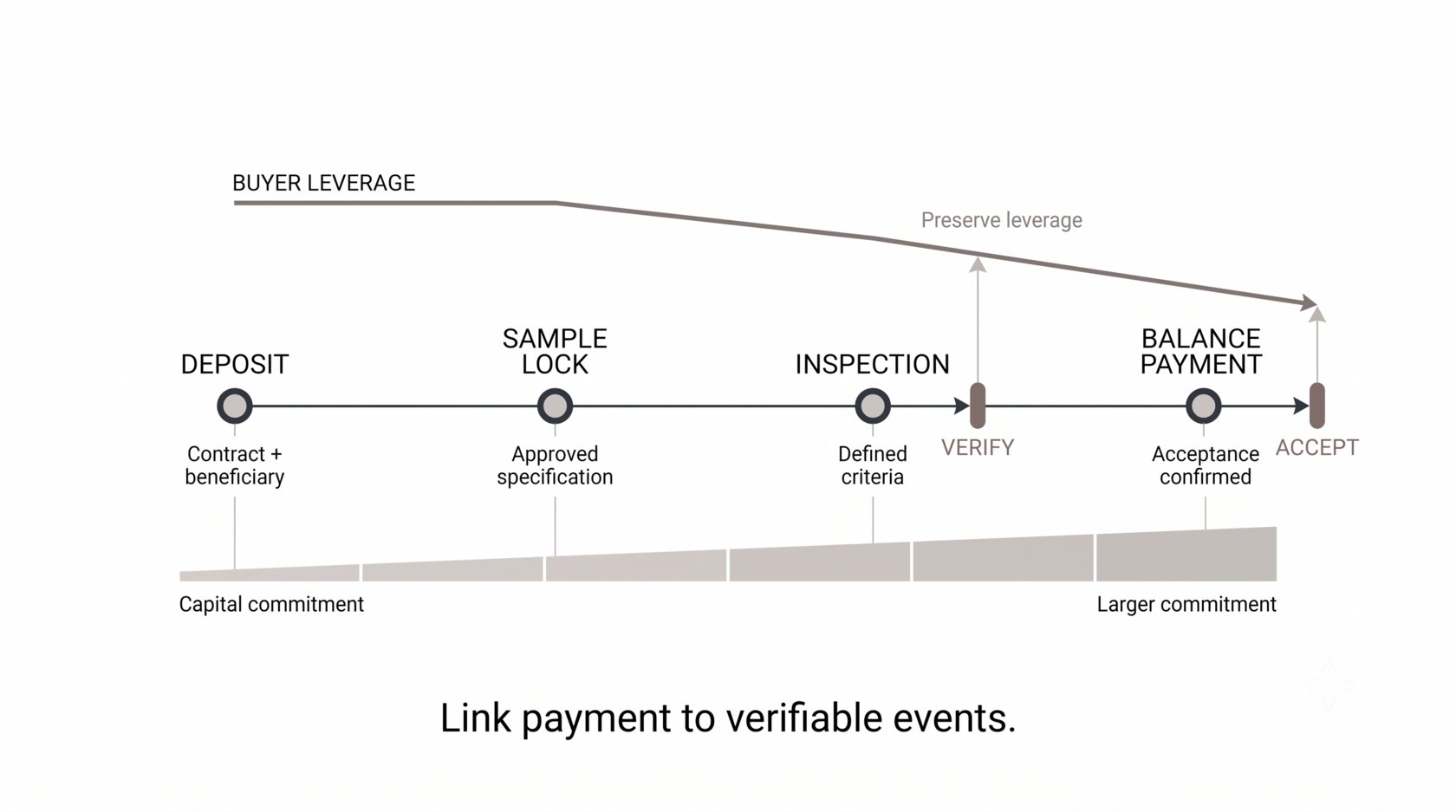
Control before payment. Preserve leverage until critical claims are evidenced. Link milestones to verifiable events; specify inspection and acceptance conditions; reconcile the beneficiary with the contract; and allocate responsibility for tooling, delays, defects, unauthorized subcontracting, failed inspection, and corrective action.
Individual checks are valuable when their limits are understood. Alibaba’s Verified Supplier program uses independent third-party assessment, including on-site inspection and a downloadable report. Alibaba also states that the assessment is conducted by third parties and does not amount to a platform guarantee of the accuracy, completeness, or continuing timeliness of the information.[7] That makes the badge useful evidence—not a transaction verdict.
How Much Verification Does This Transaction Require?
Match the work to the cost of failure, loss of leverage, and difficulty of replacement, not to a universal dollar threshold. A search for “China factory audit cost” will return widely different figures because pricing varies with auditor-days, location, technical scope, report requirements, travel, specialist expertise, and whether follow-up is included. Compare written scopes, not headline prices, because a one-day general audit and a product-specific technical assessment do not answer the same question.
What You Can Verify Yourself — and Where the Evidence Stops
You can verify Chinese supplier basics without outsourcing every step. Obtain the exact Chinese legal name and business license; search the official registry; compare the license, quotation, PI, contract, seal, website, and beneficiary; reverse-search photographs; download any marketplace assessment report; verify certificate details with the issuing or accreditation system; and ask direct questions about the production site and subcontractors.
Be careful with claims about export history. China Customs’ public platform can confirm customs filing and public credit information, but it is not a complete public ledger of every shipment. If shipment experience matters, request transaction-specific evidence such as redacted customs declarations, bills of lading, or customer-authorized references, and treat commercial trade databases as leads rather than conclusive proof.
Independent help becomes rational when several legal or payment entities must be reconciled, Chinese-language records require interpretation, bank instructions change, product-specific compliance remains unclear, the factory relationship is undisclosed, tooling or launch exposure is material, or the supplier refuses proportionate verification. The cost should be compared with the cost of a failed order, not only with the supplier’s quotation.
Be careful with claims about export history. China Customs’ public platform can confirm customs filing and public credit information, but it is not a complete public ledger of every shipment. If shipment experience matters, request transaction-specific evidence such as redacted customs declarations, bills of lading, or customer-authorized references, and treat commercial trade databases as leads rather than conclusive proof.
Independent help becomes rational when several legal or payment entities must be reconciled, Chinese-language records require interpretation, bank instructions change, product-specific compliance remains unclear, the factory relationship is undisclosed, tooling or launch exposure is material, or the supplier refuses proportionate verification. The cost should be compared with the cost of a failed order, not only with the supplier’s quotation.
What an Arbitr Pre-Payment Transaction Review Includes
An Arbitr Pre-Payment Transaction Review is a focused review of one proposed supplier transaction before a deposit, tooling payment, or other meaningful commitment. It is designed for a buyer who has already identified a supplier and needs a structured decision on the evidence and controls, not a generic supplier score.
The entry scope is one proposed transaction and one principal supplier, with up to two related legal or payment entities, one quotation, PI, or draft agreement, payment instructions, available supporting evidence, and one written client clarification round. Additional entities, supplier interviews, urgent work, on-site audits, inspections, legal opinions, laboratory testing, or technical compliance reviews require separate scope.
Findings are reported on separate dimensions: Evidence alignment — Aligned Within Scope, Incomplete, or Contradictory; Transaction exposure — Limited, Material, or High; and Required controls — documentation, independent confirmation, revised payment structure, remote verification, audit, inspection, or pause payment. These are not collapsed into a numerical score or a binary safe/unsafe verdict.
The initial review is document- and evidence-based. It does not automatically include an on-site factory audit, physical product inspection, formal legal or contract-enforceability opinion, product certification, laboratory testing, supplier contact without separate authorization, performance guarantee, fund recovery, enforcement, or litigation. The client retains the final commercial decision.
Frequently Asked Questions
Can I verify a Chinese manufacturer myself?
Yes, to a point. You can confirm the legal identity, compare names across documents and payment instructions, verify certificates, reverse-search images, and request a live walkthrough. Independent review becomes useful when entities do not reconcile, payment instructions change, the factory relationship is unclear, product-specific evidence requires specialist interpretation, or the financial exposure makes an unresolved assumption too expensive.
Is an Alibaba Verified Supplier badge enough?
No. The badge and assessment report are useful evidence that an independent third party reviewed specified supplier information and visited the site. They do not prove that the company named in your contract and bank instructions is the assessed entity, that the audit remains current for your order, or that the specific production run will conform. Review the report’s entity, scope, date, and limitations.
How much does a pre-payment supplier review cost?
The pricing basis should be clear before work starts. Arbitr’s entry scope is built around one proposed transaction, one principal supplier, and up to two related legal or payment entities. Extra entities, supplier interviews, urgent deadlines, ownership or litigation work, audits, inspections, legal analysis, and technical or compliance review are separately scoped. Request the written fee and inclusions before authorizing the review.
How long does the review take?
The expected delivery date is confirmed before work begins after the number of entities, document completeness, language, and need for independent confirmation are assessed. A document-only review is different from a matter requiring supplier contact, a live walkthrough, an audit, or specialist input. Urgent deadlines should be disclosed at the initial fit check so the scope can be accepted or declined realistically.
Can supplier verification guarantee that an order will succeed?
No. Verification cannot guarantee future production, delivery, quality, or recovery. It reduces avoidable uncertainty by identifying which claims are supported, what remains incomplete or contradictory, how much exposure the buyer is taking, and what controls should be in place before funds move. The buyer keeps the final decision and the remaining commercial risk.
Control the Transaction Before Capital Moves
Every cross-border transaction is a decision made with incomplete information. The goal is not to eliminate uncertainty. The goal is to understand which uncertainties still matter before capital, time, and reputation become committed. Better decisions begin there.
Submit the supplier name, quotation, proposed payment details, and expected order. Arbitr will map the entity, money, production, and control chains; identify where evidence is incomplete or contradictory; and specify what should be resolved before funds move.
View a Sample Transaction Review
Supplier review reduces avoidable uncertainty but cannot guarantee future performance. Arbitr provides evidence-based decision support; the final commercial decision remains with the client.
Sources and Verification References
14.08.2026
